Virtual World Conference

— GUEST POST by ANDREAS SCHMEIL

The program of The Virtual World Conference is online now, at http://thevirtualworldconference.org

The Virtual World Conference is a unique event exploring the use of online virtual worlds for learning, collaborative work and business ventures, which will be hosted over a 24-hour period entirely in Second Life on 15 September 2010.

The one-day conference, following the sun around the globe, will bring together 21 international speakers to share ideas, showcase innovations and applications, and hold debates with a world-wide audience. This is an excellent opportunity to get a snapshot of leading research and expertise in the field, as well as network with like-minded peers.

Anna Peachey (The Open University/Eygus Ltd) and Professor Sara de Freitas (SGI/Lab Group) will chair in the European zone, with Andreas Schmeil (PARC/University of Lugano) in the American Pacific Coast time zone and Claus Nehmzow (Alcus International Ltd/Hong Kong) in the East Asian time zone.

The conference will consider how virtual worlds can change the way we learn, work and socialise, focusing on three core themes:

* Social interaction, societies and communities in virtual worlds.
* Business applications and strategies for using virtual worlds.
* Formal and informal teaching and learning in virtual worlds.

The Virtual World Conference will host trainers, experts, teachers, policy-makers, managers, consultants, tutors and researchers from industry, academia, schools and policy development, with representation from a wide range of different sectors including:

* Education: schools, colleges and universities.
* Research: universities, institutes, industrial labs.
* Training: training organisations, private foundations.
* Industry: international companies, SMEs.
* Health: hospitals and training institutions, care trusts.
* Environment: planning agencies, environmental agencies, emergency response organisations.
* Government: central government departments, agencies and local government authorities.

For more information, and to register, please see the website at www.thevirtualworldconference.org

Like This! Add to FacebookAdd to DiggAdd to Del.icio.usAdd to StumbleuponAdd to RedditAdd to BlinklistAdd to TwitterAdd to TechnoratiAdd to Yahoo BuzzAdd to Newsvine

Start-ups’ branding

Our article “Brand new ventures? Insights on start-ups’ branding practices” has just been published by the Journal of Product & Brand Management (Vol. 19 Iss: 5, pp.356 – 366, 2010).

The paper aims to shed light on the specificity of branding approaches for young companies for the reason that branding is a crucial activity for the survival and success of a newly established firm as it facilitates finding and maintain customers.  Adopting a case study methodology, mainly through in-depth interviews with CEOs and communication managers, 15 of the largest and most successful start-up companies of Switzerland were analyzed.

The paper establishes an overview on the current practices and rational of the brand building activities choices, and on the emblematic pitfalls regarding branding of new ventures. It suggests that young companies should not be forced to compare their branding strategies to multinational firms and proposes a framework and key guidelines for start-up branding.

The proposed visual framework and guidelines can be relevant for future entrepreneurs and brand consultants, to orient and better motivate their decisions toward branding creations and development for new and young ventures.

Like This! Add to FacebookAdd to DiggAdd to Del.icio.usAdd to StumbleuponAdd to RedditAdd to BlinklistAdd to TwitterAdd to TechnoratiAdd to Yahoo BuzzAdd to Newsvine

Knowledge Visualization at I-KNOW 10

Our research group had two presentation and a poster (see last week’s post) at the I-Know conference 2010.

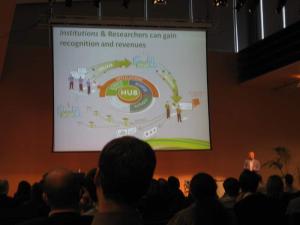
Martin Eppler presented his research with Alice Comi on inter-organizational knowledge sharing (in the picture below). They found that groups using visual representations are more productive than groups using traditional plain paper. And interactive visualization (= computer-based) is better than paper templates.

Then Nicole Bischof talk focused on clarity and gave practical insights on how to make power-point presentations more clear. tips include having a clear structure and not putting too much text on the slides. The study respondents also reported that misspelling was not an issue, while skipping slides seems to be very irritating for the audience!

Like This! Add to FacebookAdd to DiggAdd to Del.icio.usAdd to StumbleuponAdd to RedditAdd to BlinklistAdd to TwitterAdd to TechnoratiAdd to Yahoo BuzzAdd to Newsvine

I-KNOW conference 2010

The I-KNOW conference just took place in Graz, Austria.
Lots of talking about visualization, starting with the first keynote Marti Hearst (UC Berkley). In her plenary talk she emphasized the trend toward more and more audiovisual communication at the expenses of text. We are glad to know that 🙂 She was presenting directly from her ipad, and somewhat surprising her slides didn’t have much of audio-visual material; but the second keynote, Rafael Sidi of Elsevier, had plenty of beautiful images (as in the picture on the right).

At the conference exhibit, Microsoft was showcasing Surface, the multi-touch and multi-user screen. It’s a table with several cameras inside that recognizes natural hand gestures as well as objects.
Steve jobs would say “it works like magic”, and indeed it seems so, although it’s quite more expensive and heavy than an ipod/ipad. It seems useful for collaborative knowledge work in organizations. Although I guess tha orientation remains an issue, it’s fun!

Like This! Add to FacebookAdd to DiggAdd to Del.icio.usAdd to StumbleuponAdd to RedditAdd to BlinklistAdd to TwitterAdd to TechnoratiAdd to Yahoo BuzzAdd to Newsvine

I-KNOW10 Knowledge visualization

Our poster at the I-KNOW 10 conference: Conveying Strategy Knowledge Using Visualization vs. Text: Empirical Evidence from Asia and Europe


Click to download pdf

Like This! Add to FacebookAdd to DiggAdd to Del.icio.usAdd to StumbleuponAdd to RedditAdd to BlinklistAdd to TwitterAdd to TechnoratiAdd to Yahoo BuzzAdd to Newsvine

Sketching at work

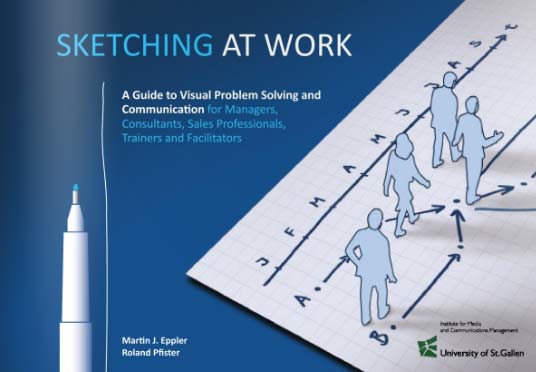
The new book of our research group is now online: Sketching at Work. A guide to Visual Problem solving and Communication for Managers, Consultants, Sales Professionals, Trainers and Facilitators.
For the interactive version see: www.sketchingatwork.com

Like This! Add to FacebookAdd to DiggAdd to Del.icio.usAdd to StumbleuponAdd to RedditAdd to BlinklistAdd to TwitterAdd to TechnoratiAdd to Yahoo BuzzAdd to Newsvine

Harvard Business Review on Visual Facilitation

The magazine of Harvard Business Review in September is featuring an article on visual facilitation in business:
Vision Statement: Tired of PowerPoint? Try This Instead.

Graphic recording (or visual facilitation) consists in capturing in a graphical form the discussion and the interaction of a meeting. It’s a valid alternative to powerpoint, useful both to summarize the group conversation “but also as visual references for key goals or processes.” “The goal: to help people make connections and better recall key points.” (HBR).

It comes in the form of large paper murals drawn by specialized artists, or in an electronic form, supported by graphic facilitation software that projects the collaborative visualization, and has the advantage to get the participants highly involved because they are creating the visual representation themselves.

Oh that’s the topic of my research, by the way 😉

Like This! Add to FacebookAdd to DiggAdd to Del.icio.usAdd to StumbleuponAdd to RedditAdd to BlinklistAdd to TwitterAdd to TechnoratiAdd to Yahoo BuzzAdd to Newsvine

Visual search

visual search engines are getting more and more useful and popular. So popular that Google is said to be interested to acquire them, according to today’s news on the Wall Street Journal Europe.

Like.com is a comparison-shopping website from California, that allow the users find cloths that look alike (see the picture below). A similar function, based on image recognition technology, is offered by the Pixazza Inc. that “helps Web users purchase products they see in photos on some celebrity or home-design sites” (WSJE).

Like This! Add to FacebookAdd to DiggAdd to Del.icio.usAdd to StumbleuponAdd to RedditAdd to BlinklistAdd to TwitterAdd to TechnoratiAdd to Yahoo BuzzAdd to Newsvine

Mapping Change, Changing Mappings: SMS extension in Venice

The Strategic Management Society is organizing a one day Workshop on “Mapping Change, Changing Mappings: Conceptual Shifts in Strategy“, in Venice September 10th 2010.

In the morning it “will be addressing the most fundamental theoretical perspective on conceptual change in strategy and their dynamics”. The afternoon will focus”on how representations and “tools” based on representations (e.g. of a visual, or a narrative kind…) are integrated in managerial practice and how they can be used to promote shifts in a strategy concept.”

This academic panel from prestigious universities of Europe and U.S. is using novel and intriguing concepts and wordings, such as “concept morphing by metaphors”, “analogies and blends in strategy” and “grammar of conceptual shifts in strategy”.
Sounds very promising! I hope they’ll have some documentation online.

Like This! Add to FacebookAdd to DiggAdd to Del.icio.usAdd to StumbleuponAdd to RedditAdd to BlinklistAdd to TwitterAdd to TechnoratiAdd to Yahoo BuzzAdd to Newsvine

Visual representations @ Academy of Management meeting

The Academy of Management annual meeting just took place in Montreal (August 6-10, 2010) with 8000 participants from 80 countries. This huge and prestigious event has pulled together scholars from all facets of management, from entrepreneurship to social innovation, to managerial education with new media and hardcore management theory. Despite 1801 sessions were organized, only a handful of them were dedicated to visual representations, with different names:

The power of representations

– Our paper at the Knowledge sharing and online communities paper session

– A paper on Coherence and Visual Representation as Knowledge Creating Devices in Strategy in the paper session Shooting for the moon: The role of cognitive schema and mental maps

Teaching Design Thinking symposium in management education

– A paper on Cognitive Maps as Visual Artifacts for sensemaking and sensegiving in IS implementation

Somewhat relevant to visual representations I found as well:
– symposium on documentary films on organizational behaviors: What’s Wrong with This Picture? Critical Documentary Film as a Catalyst for Change
– Learning on second Life at the workshop on Sustainable Business Practices: Experiential Learning in Virtual Environments

In the picture an image from the conference presentation on Coherence and Visual Representation as Knowledge Creating Devices in Strategy by Tally Fruchtman Rossiter, who has an interesting blog on visualization

Like This! Add to FacebookAdd to DiggAdd to Del.icio.usAdd to StumbleuponAdd to RedditAdd to BlinklistAdd to TwitterAdd to TechnoratiAdd to Yahoo BuzzAdd to Newsvine