DGPuK Organizational Communication 2011 Fribourg

The Annual Divison Conference of the German Communication Association
PR and Organizational Communication 
took place November 3-5th 2011, in Fribourg, Switzerland. I presented the results of my latest study, comparing the reception of strategy communication in Europe, East Asia and South Asia: “Organizational Communication in Europe and Asia: enhancing commitment to the strategy with culturally appropriate knowledge visualization”.
The topic for this year conference is “International and Comparative Research in Organizational Communication and Public Relations”, organized by Prof. Diana Ingenhoff.
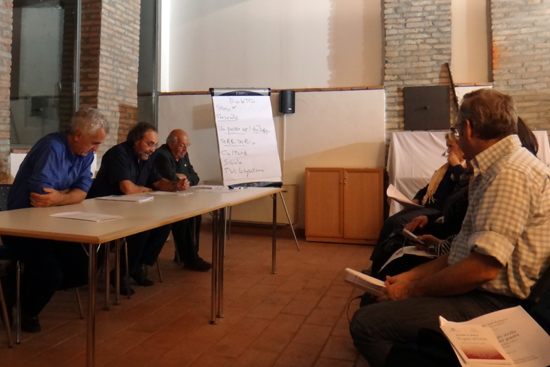
The opening panel discussed the definition of PR and Organizational Communication in different cultural context (U.S., U.K., Germany).
Then researchers presented their latest studies: Andreas Schwarz had a very interesting presentation on “Crisis communication across borders: A culture-sensitive approach”. Useful insights and tips for publishing in PR and Organizational communication have emerged by the study of Swaran Sandhu, who presented “Publishing abroad? The international visibility of PR research from German-speaking countries”.
Dennis Schöneborn adopted an American perspective on Organizational Communication for discussing recent organizational phenomenon, presenting “The communicative constitution of global partial organizations”.
I was very plesed to see that he both Dennis and Swaran made extensive use of visualization in their presentaton and have also conducted research on visualization for organizational communication.
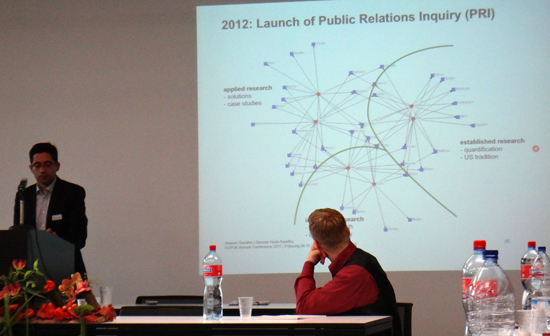
Finally, I enjoyed the presentation of Prof. Ingenhoff research group on “An international comparison on the influence of culture on online communication by Non-Profit-Organizations”, where they have used Hofstede dimensions for assessing and comparing NPO’s websites in different countries.
Network and career

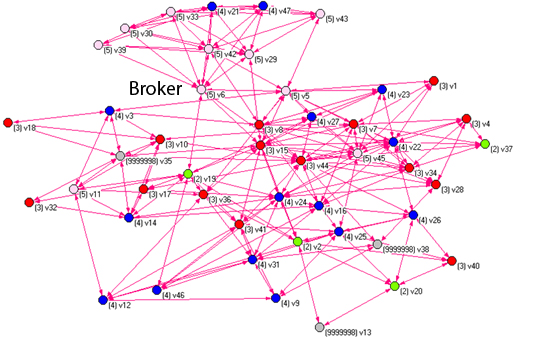
Working hard is not enough. We might all have had the feeling that networking can help in career development. But how? Who should you network with? Is networking equally effective for men and for women? Prof. Carnabuci gave a very interesting seminar on the topic, organized by the Equal Opportunities service of the University of Lugano. Based on insights from recent research in social network analysis, it seems that being a “broker” is a successful strategy. Perhaps for men only.

Green timeline

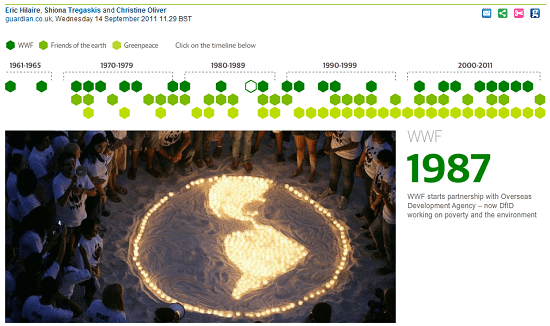
The Guardian has created a nice  interactive timeline of green movements. It portraits the major events of WWF, Greenpeace and Friends of the Earth in the occasion of their 50° and 40° anniversary, respectively. Click on the image to see the interactive version.
(Re-posted from Rahel’s blog Kosmos 9)

Brescia Dialect. Or rather, Lombard language.

A series of lectures on “Dialetto Bresciano” (Dialect of Brescia) is taking place in Lonato del Garda every Friday of October. I appreciate and support this cultural initiative, aimed at saving the cultural heritage of this land, without linking itself to secessionists parties. Indeed dialect is often and erroneously associated with the will to differentiate and divide the various Italian regions. The lectures, titled “Un passo nel futuro – Quater venerdé de dialèt” is aimed at preserving this language which is very much threatened by modern times. Indeed most people below thirty years af age do not speak the local language and the Bresciano dialect might disappear in a few decades. 

The dialetto Bresciano is a Lombard dialect, or rather, a lombard language, similar to the Milanese. What in italian are called “dialetti” are actually languages and not just dialects of Italian. They are the heritage of the history of the Italian peninsula, fragmented in many states until 150 years ago. When Italy was created, one of the languages was chosen, which we now call Italian. However it was not until the time that TV spread in the 60s that most of the population of Italy actually learned the language. Indeed my grandparents, born in the 1920s,  expressed themselves in dialect only, and could barely speak Italian.

The lectures, given by Claudio Bedussi, give insights on reading and writing in dialetto bresciano, and give voice to prestigious local poets, including Dino Marino Tognal, Fabrizio Galvagnini, Dario Tornago and Armando Azzini.

Management Atlas book

Management Atlas is a new interesting book on knowledge visualization for management by Martin J. Eppler and Jeanne Mengis (in German). The idea of the book is to make management methods, strategies and tools more easily accessible to practitioners by representing them through visual metaphors. The 37 colourful metaphors are grouped together in three continents: methods for the individual, methods for the team, and those for the organization. The authors have chosen often unusual and fun metaphors to think of management problems and approaches: information overload as a dam lake, team development as a rollercoaster, risk management as a black swan, or the polarisation effect in teams as a swing. More information can be found on the book blog or editor website.


Vargas Llosa @ Uni St. Gallen

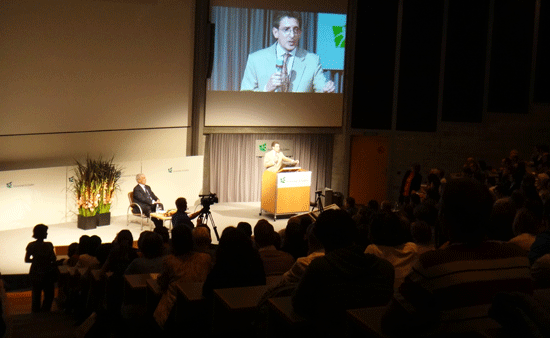
Mario Vargas Llosa, literature nobel prize laureate 2010, gave a public  lecture at the University of St. Gallen on Sept 21st, organized by prof. Yvette Sanchez. The Peruvian ambassador (see the picture below) opened the talk with provocative statements, citing the very first lines of the author’s book “Conversation in the Cathedral”, explaining how Vargas Llosa’s writings influenced his perception of Peru and of the need of change for the country. He was followed by a speech of the ambassador of Spain, as “don Mario” is also a Spanish citizen.
His talk addressed the relationship between history and literature, and the search for truth. Answering questions from the public he explained his take on what is truth, based on Karl Popper view.
My favourite quote: for clear writing you need a clear mind.

ICIG symposium – IE Segovia

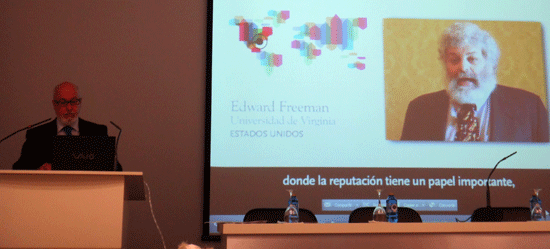
The 14th ICIG Symposium took place on September 14th to 16th organized by John Balmer and Laura Illia. It was an honor to be invited to this prestigious event, and a pleasure to meet and listen to very well-known researchers of corporate identity field. I presented my work on the changing visual identity of start-up companies. Thank you Laura for the wonderful organization!

The symposium was held at the Segovia campus of IE University (Spain): the location is just awesome. Some teaching rooms have roman ruins, like in a museum! (see picture below)

Global competencies @ AoM

I dedicate an entire post to my favourite session of the conference: “Global Competencies: East and West, The Pursuit of the Complementarities” organized by Rosana Silveira Reis and chaired by Sherlan Leonardo Cretoiu, (Fundacao Dom Cabral, Brasil).

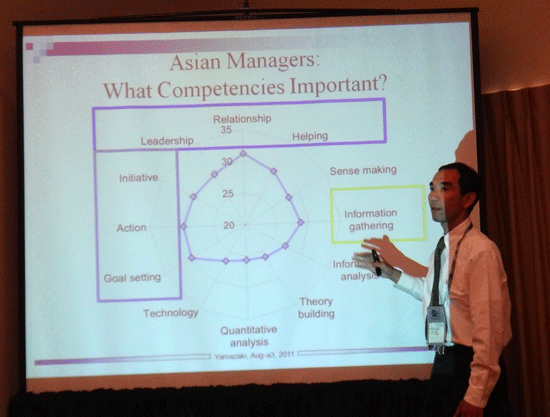
Prof. Yoshitaka Yamazaki (picture below) from Japan presented is study about important competencies of Japanese managers operating in Asia and in the West, respectively. He outlined that there are common competencies for leaders, including leadership, initiative, action. However Japanese managers working in the west feel more ned to develop certain competencies, such as relationship building.

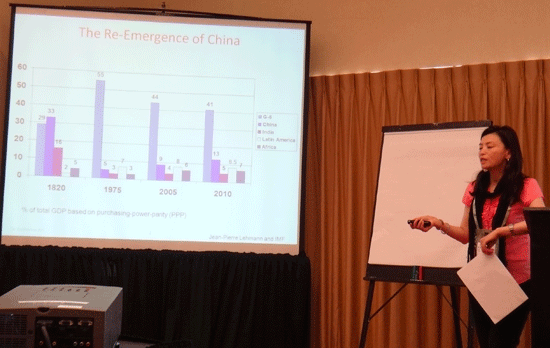
Professor Katherine Xin (below) from Shanghai talked about the Re-emergence of China. She explained that Chinese companies are following tree main globalization paths: internal growth, strategic alliances and M&A. They typically acquire global competencies by sourcing talent from abroad. She illustrated a company case, recruiting Japanese retired managers.


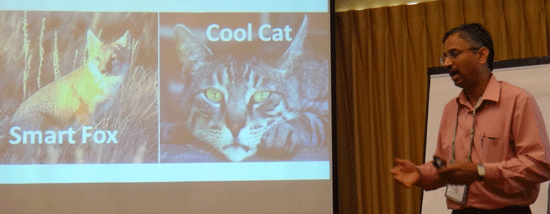
Professor Prasad Kaipa (below) of the Indian School of Business compared India with the U.S. He gave a very informative talk with tips for good management (most important is to get things done) and concrete company examples from Apple, Tata and the Silicon Valley area. He provided entertaining stories like the metaphor of the smart fox and the cool cat, as two perspectives of management approaches.

Social Entrepreneurship @ AoM

Social entrepreneurship is attracting a large and growing interest at the Academy, reflecting its increasing popularity. A number of PDW and Symposia were organized on the topic, and most of them were fully booked including “Social Entrepreneurship and Broader Theories: Shedding New Light on the Bigger Picture” organized by Susan Mueller.
Johanna Mair, a well known researcher in this area, presented a framework (in the picture below), with 3 main elements: theory, methods and phenomenon. Her colleague Lisa Hehenberger presented their research on Venture Philanthropy.

The session “Entrepreneurship in the Social Context: Is it Really Different?” was remarkable, and it included talks on “How Social Entrepreneurs Define Success”, cross-national variation in social entrepreneurship, how social is different from commercial entrepreneurship (double bottom line: social + commercial). Zev Lowe (ESADE Business School) presented “Design-Driven Social Ventures: An Alternative to the Community-Led Approach” with two fascinating cases: KIVA and Worldreader.

Academy of Management 2011

“The 2011 Annual Meeting program has over 1600 total activities involving more than 8000 people from 78 countries. ” (Souce: Aom meeting website)Program: http://program.aomonline.org/2011/subMenu.asp?mode=setmenu&menuid=14

The biggest and most prestigiuos management conference in the world is taking place in San Antonio Texas.

As an organizational communication researcher, I was more than happy to see the Distinguished Service Award given to Linda Putnam, professor of Commication, and very prolific writer on the topic of organizational communication.