Today we concluded the Visual Literacy for Management course at the University of St. Gallen with great presentations. Thank you to all the students for a great semester!

Today we concluded the Visual Literacy for Management course at the University of St. Gallen with great presentations. Thank you to all the students for a great semester!
Today I witnessed an innovative presentation modality: a facebook page instead of the usual PPT. Although unusual, the medium fits very well the topic of the presentation, which is about the corporate culture at Facebook.
My students of the Organizational Behaviour course uploaded their presentation on this facebook page and made us experience how it feels working at facebook: in fact the presentation lasted longer than usual, but they gave us free sweets during the presentation, to keep us motivated… exactly like Facebook is doing in its offices (free food, many benefits, but work many hours). Brilliant and creative, well done!
You can check out the presentation at https://www.facebook.com/organisationalbehavior?ref=profile
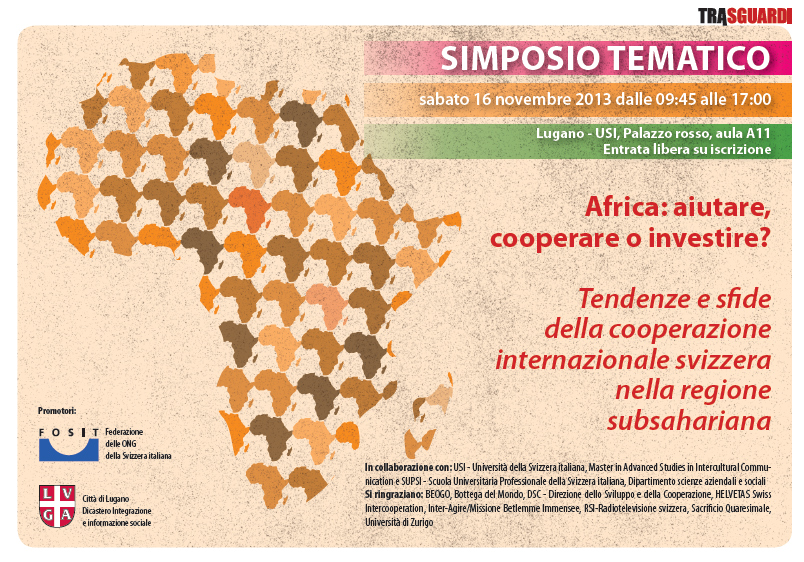
Last Saturday November 16th 2013, the Symposium “Africa: help, coopertate or invest?” took place in Lugano, organized by Fosit and MIC.
It started off with an introduction to the topic by Prof. Veglio, president of FOSIT and professor at the university of St. Gallen, followed by a roundtable discussion. The guest speakers were Blandine Sankara (sister of the Thomas Sankara, President of Burkina Faso from 1983 to 198, murdered 26 years ago.) Prof. Katharina Michaelowa (ETH) e Chrystel Ferret (SDC); moderated by Roberto Antonini (TSI).
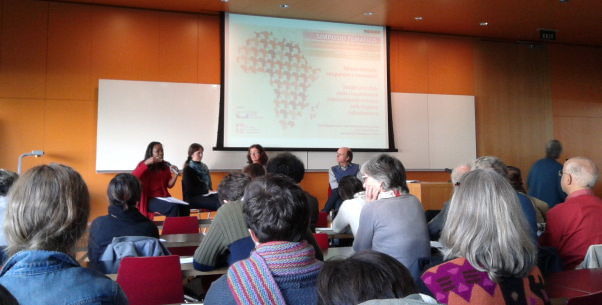
In the afternoon, three different Atelier were organized. The pictures below refer to Atelier 2 on Microfinance.
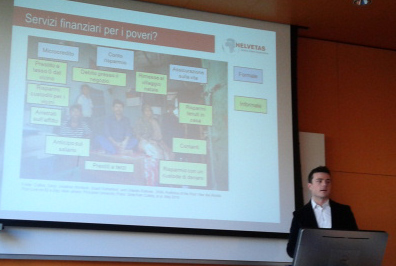
The topic was introduced by Damiano (student at the University of St. Gallen), who gave an insightful overview on the status of microfinance in the world. I particularly like the visualization below, which maps the situations in which people need (micro-)loans or other financial products such as micro insurances, and what elese they normally do if they can’t get them from a bank.
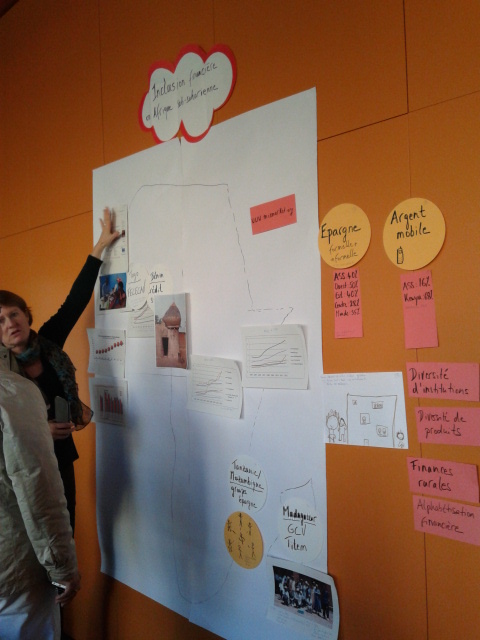
Then Isabelle Dauner gave a talk on the topic of microfianance specifically in Africa, using a ‘analogue’ technique, drawing the ouline of Africa and then pasting different information, sldes, drawings and coloureful notes on the poster.
“It isn’t normal to know what we want. It is a rare and difficult psychological achievement”
Abraham Maslow (In Business model you pg. 125)
Coaching, mentoring and personal development programs are usually based on dialogue. Talking is certainly useful, but we visualizing, drawing and sketching can provide additionl help for understanding yourself and your potential. Starting with this post, we’ll showcase a series of templats and examples on the topic of personal development and leadership through visual mapping.
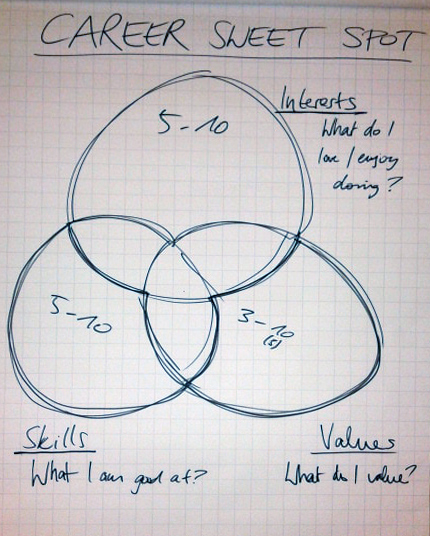
A first example is the career sweet spot. The example below has been drawn by Sebastian Kernbach, researcher at the University of Lugano, adapted from the sweet spot of the book “Business Model you” by Timothy Clark, Alexander Osterwalder and Yves Pigneur (pg.114). In contrast with the original sweet spot, the figure below invites you to consider your values, in addition to your skills and interests.
What is the sweet spot? This quite well known visualization is a Venn diagram with three overlapping circles. The circles represent skills, interest and values. You can easily draw it yourself and fill it in with information about yourself.
The “sweet spot” is the overlap of the three: that is, he skills which match your interests and your values. In most cases we have a set of skills which are useful for our job/studies, but maybe our current job is not alligned with our personal interests and our core values.
Using this template can help you identify if there is a good overlap between the skills you have and what really matters for you. If the “sweet spot” is empty or not very populated, you might need to focus on acquiring skills that are closer to your values and interests, to gain more satisfaction from your daily activities.
In the Visual Literacy for Management course we had the pleasure to have a guest lecture by Rahel Aschwanden, of the Impact Hub Zurich, on How to Become a Social Entrepreneur.

After explaining what is SE, and how the Impact Hub can help social entrepreneurs, Rahel conducted an interactive excercise with the class.
She asked the course participants to identify the major problems of our society, think about a possible solution for a specific problem and then propose it in a group to get feedback. Even in few minutes many interesting ideas were proposed, such as a “packaging consultancy company” to advice companies on how to develop environmental friendly packages for their products. Well done!

CERN, the European Center for Nuclear Research, opened its doors to the public last weekend. CERN is the biggest particle physics laboratory in the world, where you can find the hottest and the coldest place in the universe. The thousands of physicists who work at CERN constantly conduct numerous experiments to “explore the fundamental components of nature and to study the forces that shape our universe”.
The event was very well organized, Swiss efficiency, but the view of the ATLAS – which is the biggest detector ever constructed – was quite disappointing:
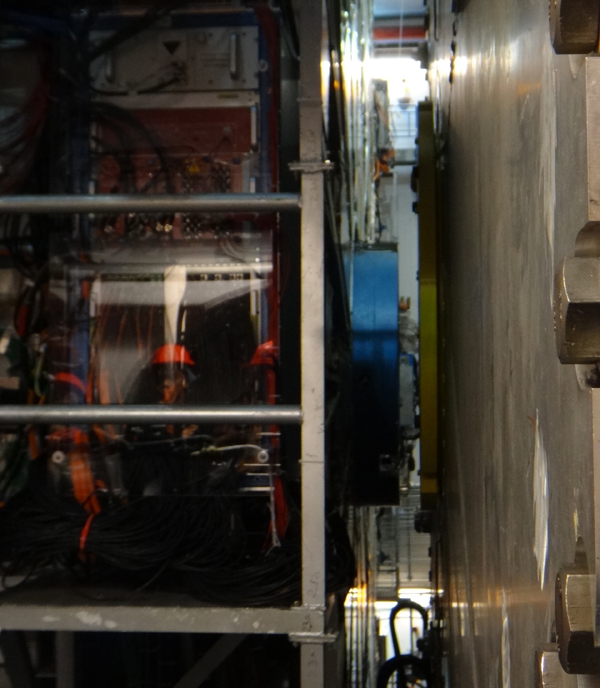
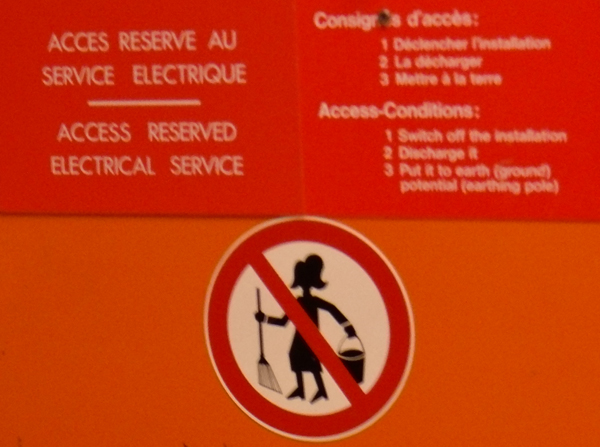
It was fun to see the “backstage” of the largest and most advanced research center in the universe. Beside discovering the Higgs boson, they seem to have issues keeping out the cleaning staff from radioactive areas!
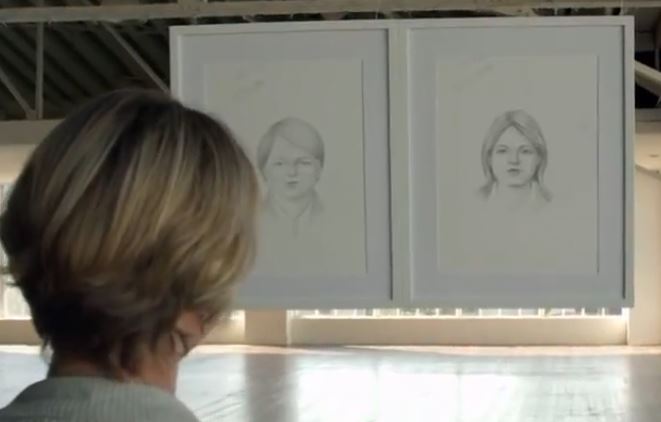
Dove’s recent ad “Real Beauty sketches” shows a number of interesting phenomena: first, visualizing how you see yourself and how others see you, can be revealing. Women often see themselves is less positive terms than others see them. Research indeed shows that women has lower self-esteem than men, on average. And the sketches help them to realize this dangerous negative attitude.
Mashable recently offered a review of the best ‘design collaboration tools’ which are available online for free: http://mashable.com/2013/08/06/design-collaboration-tools/
These online tools allow to share documents and feedback within a (dispersed) team or with clients. They allow to write feedback and to visually annotate the designs or graphics.

Thanks Rahel for the hint
Estamos listos for the course “Intercultural Management Communication”, at the Universidad del Pacifico, in Lima, Peru!
The course presentation is available in interactive and in printable (pdf) format: http://prezi.com/d8lumkgjmzug/?utm_campaign=share&utm_medium=copy&rc=ex0share
This is the link to the presentation on “Doing business in India” which I’m giving at the Universidad del Pacifico, in Lima (Peru), on Tuesday August 20th.

 Sabrina Bresciani, Ph.D.