Visualizing information increases positive emotions

Our article “Augmenting Communication with Visualization: Effects on Emotional and Cognitive Response” has been published on the IADIS International Journal on WWW/Internet, Vol. 9 (2), pages 109-121, and it is now available online.

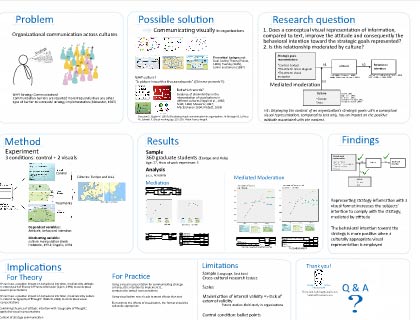
In this work, co-authored with Margaret Tan and Martin Eppler, we argue that mapping information visually with diagrams and visual metaphors has a positive effect on the emotional reaction toward the content. That means that people like the content better when it is presented in a visually appealing manner.

Paper abstract: We are witnessing an increased use of conceptual visualizations and information graphics on the Web. Addressing this rising interest in the interactive visual display of information, this study proposes to evaluate the effects of visual mapping on human communication. We acknowledge the emergence of new forms of communication deploying interactive visualization, empowered by ICT tools that augment abilities in creating visualizations. Yet their implications are still largely understudied. Beyond evaluating usability, this study focuses on assessing the new visual digital form of communication, in particular in the context of strategic communication in organizations, by analyzing the relationship between the emotional and cognitive response. We propose a model, building on theories from psychology, in which visualization has a positive effect on the emotional response toward the content, which in turn has a positive impact on the cognitive response. We test the mediation model proposed with an experiment, comparing a textual control condition to two visual representations, and find confirmation of our hypotheses. The study provides a contribution by showing that communication can be shaped and enhanced by using interactive visual mapping tools, which empower users to swiftly craft clear and convincing messages.
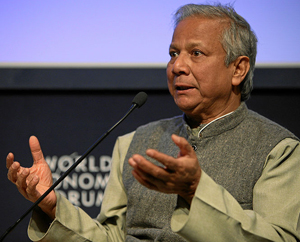
Muhammad Yunus in Switzerland, May 2012

Muhammad Yunus, Nobel Peace Prize Laureate, will be in Lugano and Zurich in May 18th and 19th 2012. The event is organized by Social Business Earth, the first social business in Switzerland funded by Samantha Caccamo. The event will start in Lugano, in the aula magna of the university at 5pm and will continue in Zurich the following day in Zurich at Hüb Zurich at 10 am.
Professor Yunus, from Bangladesh, is the founder of the Grameen Bank, the inventor of micro-credit and author of Banker to the Poor; A World Without Poverty: Social Business and the Future of Capitalism (2008) and Building Social Business: The New Kind of Capitalism that Serves Humanity’s Most Pressing Needs  (2010).

According to the organizers, the objective of the conferennces is “Raising awareness on the concept of Social Business in Switzerland to serve humanity’s most pressing needs and spearheading new initiatives in the private, public and social sectors through Social Business”. The keynote speaker will be Professor Muhammad Yunus, Nobel Peace Prize Laureate. Professor Yunus himself will grace the conference and interact personally with participants from various walks of life as he looks to promote his concept of social business throughout the world. Social Business aims to offer an alternative to profit maximizing businesses, utilizing economic tools to solve social problems in financially sustainable ways and fostering a more humane capitalism to change the world.” (Source: Social business earth).
Registration is now open.

Business Model Ideation @ EURAM

Our research on “Business Model Ideation: An Experimental Approach for the Evaluation of Team-Based Methods” has been accepted to be presented at the EURAM Annual conference in Rotterdam, 6-8 June 2012.

Abstract excerpt:
We have conducted a comprehensive literature review and develop a model to examine the effectiveness of different methods for the generation of business model ideas. The model comprises both objective and subjective effectiveness measures. In a first empirical application of the model in an experimental setting, we have compared the effectiveness of the business model innovation canvas, collaborative sketching, and brainstorming to generate novel business model ideas. The initial results suggest that the model is suitable for comparing different methods: it discerns key indicators of effectiveness, important tradeoffs between quantity and quality of ideas, and between satisfaction and the ability to select the best idea.

Collaboration Cards for Team Productivity

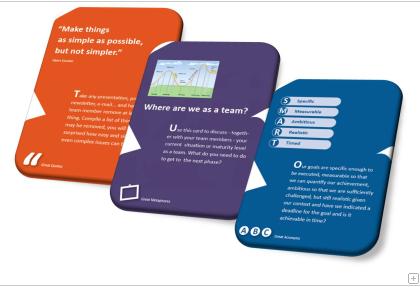
Collaboration Cards is a portable, interactive, and highly useful toolbox for team leaders, facilitators, trainers, and project managers, developed at the University of St. Gallen, =mcm institute.

They provide meeting facilitators and participants with ready-to-use cue cards, methods, exercises, inspiring quotes, and key questions to move meetings along productively and share what particpants know, more effectively through simple graphics and instructions.

Source (text and picture): www.collabcards.com

Seminar on Knowledge Visualization at IIMA (India)

I had the honor to be invited to give a seminar on Knowledge Visualization at the prestigious Indian Institute of Management, Ahmedabad (India)
Here you can find the seminar presentation and the coverage on the IIMA website:

Seminar announcement and abstract:

Visualizing together for creating new business models

Our study on business model innovation through visual collaborative technique has just been published on the International Journal of Innovation Management. In this preliminary research we propose a model in which artefacts (visual templates, schetches and objects) affect the team processes in developing new business model ideas. The results of an illustrative experimental study shows that artefacts have the power to shape collaboration and creativity in innovation tasks.

Reference: Eppler M.J., Hoffmann F., Bresciani S. (2011). New Business Models Through Collaborative Idea Generation. International Journal of Innovation Management. Vol. 15 (6). Imperial College Press. DOI: 10.1142/S1363919611003751

Brand Early

The website “Fast Company” recently featured an article on branding for start-ups: “brand early, not often“. Expert blogger Emily Heyward observed that “when a client is starting a business, everything is top priority, and it is often easy to think “logo” and “design” should come later.”

Her observations and advices are very much in line with the findings of our study “Brand New Ventures? Insights on start-ups’ branding practices”. The entrepreneurs she interviewed stated, for instance: “We just want to get it out there; we’ll see what sticks and make changes as we go”. Although this kind of statements can make sense from the perspective of the entrepreneurs,  our research revelaed that after only a few years from establishment, more than half of the analayzed companies already perceive their names as too “small” and thier logos as outdated. For instance, one of the companies had the logo developed by the wife of the founder. Only after a few years their relized that the logo, the Greek letter Alpha, was not protectable nor distinctive.

They asked a professional agency to develop a new logo, however – having now over 200 employees wearing uniforms with the company logo – they told us: “it would be a big expense and at the moment there are no concrete plans for substitution”.

Thanks Martin for the hint.

NIC symposium presentation: The Geography of (Visual) Thought

Here you can find our presentation at the NIC symposium, Helsinki, December 2nd 2001: http://prezi.com/6on7jj6wye3p/the-geography-of-visual-thought/

Eurocampus in Castellon

Eurocampus is an intensive and international study period on intercultural communication of one semester organised jointly by ten European Universities, members of the EMICC-network (European Master in Intercultural Communication). In the Eurocampus programme, students from the partner universities attend classes and study together (Source: USI website).

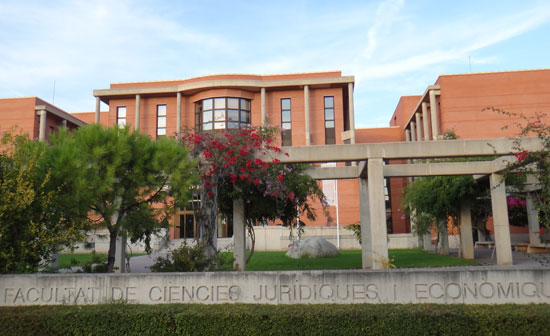
This year the Eurocampus program is taking place in Castellon, Spain, at Universitat Jaume I. I have been teaching a module on “Intercultural Aspects of Visual Communication: Conceptual Visualization, Visual and Audiovisual Documents and Information” together with prof. Stockinger (Paris).

The fantastic warm weather and the wonderful support of Professor Patricia Salazar made my stay very pleasant.
The city of Castellon is about one hour from Valencia, near the sea.