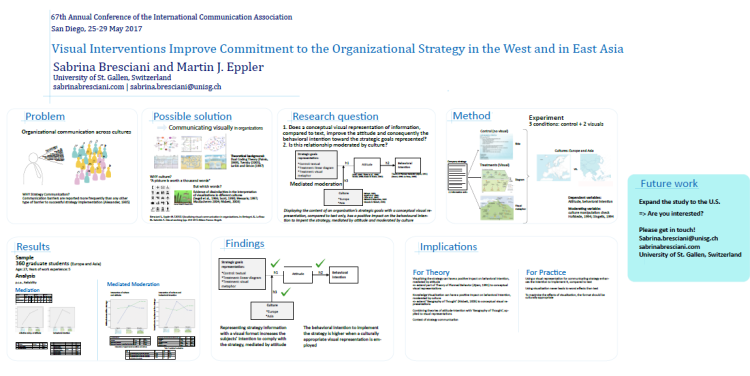
Visual interventions improve commitment to the organizational strategy – Presentation at the ICA conference 2017

Just published in the Journal of Brand Management: http://link.springer.com/article/10.1057/s41262-017-0046-4
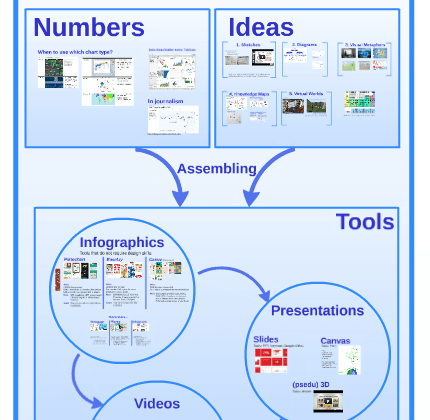
How can anyone without skills in visualization create attractive and insightful visuals for social media? In the guest lecture taking place on 27.04.2017 at 10.00 at the University of St. Gallen room 20-007, I will provide an overview of visualization tools and techniques for non-experts:
 .
.
For students of the University of St. Gallen, I can offer thesis supervision for the following topics:
 The Univesity of St. Gallen just published in the news an article about ym Field Trip to India course which took place last November.
“How can intercultural communication be learnt? Sabrina Bresciani is convinced that it’s best to do so on site. The Assistant Professor of Digital Communication at the University of St.Gallen spent a week in India with 15 students in November 2016…” Read the entire article on the Focus Magazine
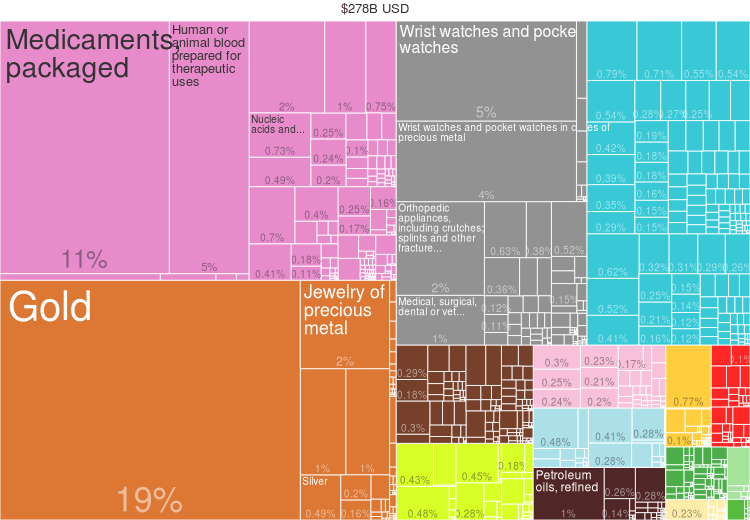
I find the Atlas of Economic Complexity very impressive and certainly worth exploring. Developed by the Center for International Development of Harvard University, the interactive Atlas application allows to explore import and export data of all counties on earth. Even more impressive, by clicking the “product feasibility” button, you get a chart with maps which products are feasible for the selected country, based on complexity and distance. You are even allowed to download and share the maps created.
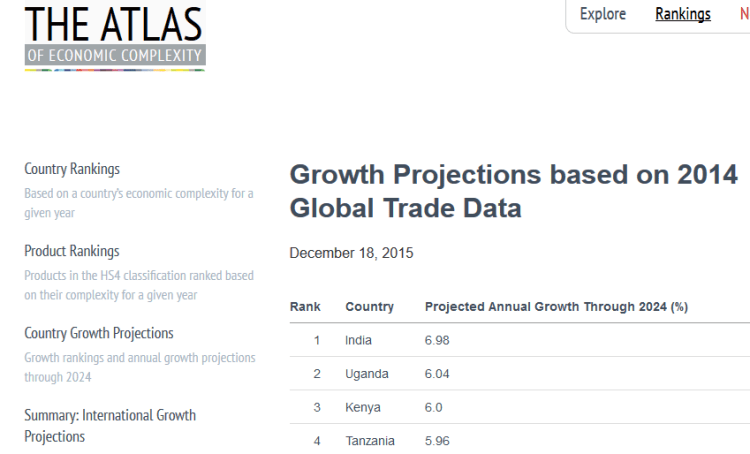
Based on this indexes, the Harvard Center for International Development New Global Growth Projections “Predict the Decade of India” with a growing rate of nearly 7%, while for China “the researchers expect to face a continued slowdown to 4.3 percent growth annually to 2024.”
Thanks Martin for suggesting the websites.
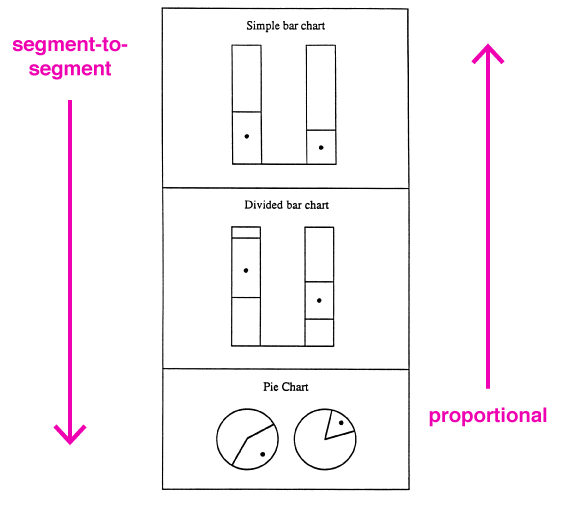
The visual journalist Kennedy Elliot compiled “39 studies on human perception in 30 minutes.” Her article is informative and easy to read, offering a great summary of the most influential articles on visualization.
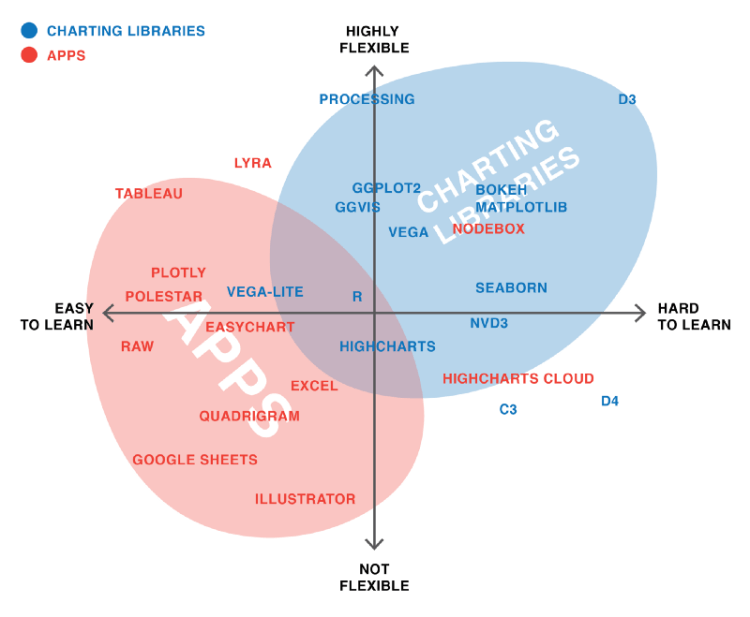
Lisa Charlotte Rost plotted the same data using 24 different visualization tools: you can read about her experience and suggestions in her excellent article with insightful figures.
Our article “Facilitating Culturally Diverse Groups with Visual Templates in Collaborative Systems: Increasing Structuration to Improve Precision” is published in Cross Cultural & Strategic Management (previously: Cross Cultural Management: An International Journal) Vol. 24 Iss: 1.
Abstract:
Purpose – The use of visual templates has proven instrumental in supporting group meetings. This study explores whether visual templates enable culturally diverse groups to achieve greater task precision in face-to-face meetings.
Design/methodology/approach – Building on Adaptive Structuration Theory (AST), it is argued that visual templates provide structuration for face-to-face meetings, even more so when they are embedded in computer-supported collaborative systems. In particular, it is hypothesized that the higher the degree of structuration imposed by visual templates, the higher the degree of task precision will be. It is also hypothesized that this relationship is positively moderated by group cultural diversity: higher cultural diversity will further sustain the positive effects of visual templates that provide higher structuration.
Findings – Results of an experiment with 229 managers from 49 countries confirm that facilitating groups with visual templates embedded in a computer-supported collaborative system significantly increases task precision at high levels of cultural diversity.
Research limitations/implications – This study contributes to Positive Organizational Scholarship (POS) by investigating the use of visual templates as a contingency factor that increases performance – specifically task precision – of co-located, culturally diverse groups.
Practical implications – Results indicate that visual templates embedded in a computer-supported collaborative system are an effective method for increasing task precision in face-to-face meetings of culturally diverse groups.
Originality/value – Theories from information systems and visualization are integrated into cross-cultural management with a view to sustaining the effectiveness of culturally diverse groups. The study sample is characterized by highly culturally diverse groups interacting in face-to-face meetings.
Keywords: multicultural groups, cultural diversity, visual templates, face-to-face meetings, computer-supported collaborative systems, structuration theories.

 Sabrina Bresciani, Ph.D.