Understanding the Impact of Visual Representation Restrictiveness on Experience Sharing

Our article “Understanding the Impact of Visual Representation Restrictiveness on Experience Sharing: an Experimental Assessment” has just been published in the Journal of Visual Languages and Computing.

Abstract:

This study investigates the effects of the restrictiveness of visuals on the communication process and outcome in small groups. Visual restrictiveness is conceived as the constraints imposed by a graphic template on the process of knowledge work. Through an experiment with ninety six experienced professionals we test the impact of a medium and a high level of visual restrictiveness compared to a control condition. As predicted, the results show that a medium level of visual restrictiveness, embodied in a grid layout, leads to higher experience sharing effectiveness. The impact is mediated by the structural pattern of appropriation of the interactive graphical template (assessed with content analysis). The implications of this study include extending the benefits and applications of visual representations to support group communication and the development (and testing) of the concept of visual restrictiveness.

Alexander, E., Bresciani, S. & Eppler, M. J. (2015). Understanding the Impact of Visual Representation Restrictiveness on Experience Sharing: an Experimental Assessment. Journal of Visual Languages and Computing, 31, pp. 30-46.
The Pitfalls of Visual Representations

We are glad that our newest articles on “The Pitfalls of Visual Representations: A Review and Classification of Common Errors Made while Designing and Interpreting Visualizations” is published on Sage Open. You can access it for free at this link.

Abstract:

A large body of research has addressed the benefits of visualization, whereas the analysis of the pitfalls has not received systematic attention. We aim to provide an overview of the common pitfalls and potential disadvantages of visual representations based on a multidisciplinary literature review. Subsequently, we develop a theoretically grounded classification of common cognitive, emotional, and social risks of visualization and populate it with a comprehensive list of visualization pitfalls. The aim of this research is not to diminish the potential of visualization, but rather to improve visual literacy by structuring our understanding of the possible limitations of graphic representations.

Reference:

Bresciani, S. & Eppler, M.J. (2015). The Pitfalls of Visual Representations: A Review and Classification of Common Errors Made while Designing and Interpreting Visualizations. Sage Open:

The Constraining Qualities of PowerPoint

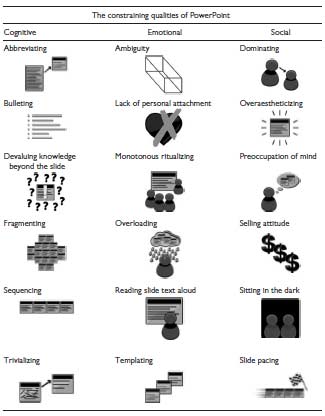
Our latest article on PowerPoint has just been made available before print on the Journal “Business and Professional Communication Quarterly”.

It contains a literature review of the “problems” that PowerPoint and similar presentation tools can create. It also includes a useful pictorial table with the classification of the major 18 constraining qualities:

classification-constraining-qualities-of-Powerpoint-Kernbach-et-al-2015

To know more about it, you can get the full article on the Journal website: Kernbach, S., Bresciani, S. & Eppler, M.J. (forthcoming). Slip-Sliding-Away: A Review of the Literature on the Constraining Qualities of PowerPoint. Business and Professional Communication Quarterly, .

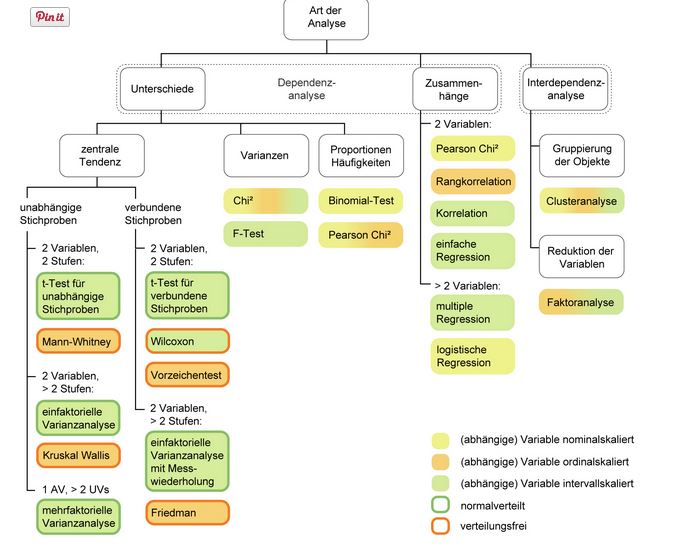
A useful visual map to navigate a website about statistics

The University of Zurich has created a very useful interactive map of statistical analyses. The map helps you decide with analysis type you need, and when you click on the specific test, it gives more information about it. A very good example of the use of visualization as a website map!

uzh website map

Presentation of the Visual Design Model

This video explains a visual model of the design process, which will be presented at the Internation Conference of Information Visualization in Barcelona on July 23th 2015.

The aim of the visual model is to assemble the main phases (and related procedures and tools) of the design process to provide a pragmatic visual guide for students and practitioners.

https://youtu.be/9j_cDeLVkRQ

This presentation is based on my paper “Bresciani (2015). The Design Process: A Visual Model. IEEE Proceedigns of the IV2015 – 19th International Conference Information Visualisation, 21, 22, 23 and 24 July 2015,  Barcelona, Spain”.

Our research at the 19th International Conference on Information Visualisation

I’m very glad to have two articles accepted for presentation at the 19th International Conference on Information Visualisation, which will take place at the University of Barcelona on July 22-24th 2015.

The first article is titled “The Design Process: A Visual Model.”

Abstract: “Knowledge visualizations are often created by practitioners and managers, not necessarily by expert graphic designers. Non-experts – as well as novice designers – can be puzzled and overwhelmed by the complexity of the design process: it is unclear how to start and which are the main phases and their sequence. Often times even experienced designers mistakenly start by selecting a tool or a solution, instead of considering the audience and its needs. The aim of this conceptual piece is to assemble the main phases (and related procedures and tools) of the design process to provide a pragmatic visual guide for students and practitioners. It also highlights the highly cyclical nature of designing through a structured iterative process of prototyping and testing. The model can be utilized for a broad spectrum of applications, including the creation of knowledge visualization, information visualizations, graphic design or other types of product. The examples provided in this paper are specifically related to knowledge visualization.”

The second article is co-authored with Marta Perez Garcia,of the Birmingham City University. We discuss “The Role of Visual Templates on Improving Teamwork Performance.” by giving evidence both from lab experiments and from field work.

Interview on Presentations beyond PowerPoint

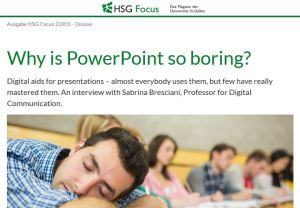
The Focus magazing of University of St. Gallen has just published an interview in which I discuss digital aids for presentations.

interview sabrina bresciani

Impact Investing and Social Finance Conference 2015

Yesterday April 28th 2015 the Impact Investing and Social Finance Conference 2015 took place at the University of St. Gallen.

It has been a remarkable event in which impressive spekers presented thier cases and opinions on the topic of Social Impact Investment, especially in the context of Latin America.

Cattura

The conference was organized by the Impact Investment organizing team: more information about the  IILA Knowledge Platform, for which I’m very gladly part of the academic network, can be found at thier website: http://www.impactinvesting.com.br/

Master of Advanced Studies in Intercultural Communication – Module on Semiotics and Visualization

Today we start the second part of Module 5 on Linguistics and Semiotics at the Università della Svizzera italiana, for the Executive Master of Advanced Studies in Intercultural Communication.

Here you can find the presentation of the course:

http://prezi.com/fvrhi63ny9it/?utm_campaign=share&utm_medium=copy&rc=ex0share

I’m looking forward to meet again the MIC 7 group!

Our research at the Academy of Management Meeting 2015

I’m very honored to have all my 3 papers accepted at the next Academy of Management meeting in Vancouver this August 2015!

The first paper is: “Intercultural Groups and Visual Collaborative Systems: Increasing Structuring to Improve Precision.” written in collaboration with Alice Comi of Aalto University, Finland. In this paper we present the results of an experiment in which groups of 5 managers from different nationalities worked together. Our results show, as predicted, that when a digital visual template is provided, both nationally homogeneous and nationally diverse groups perform better than when no visual support if provided.

The second paper is “The Effect of System-embedded Visual Restrictiveness on Experience Sharing.” co authored with Alexander, E., and Eppler, M. J. has been selected as best paper and will be included in the conference proceedings. The study examines the effects of visual restrictiveness on group process and outcome and finds that a medium level of visual restrictiveness leads to significantly better performances compared to no support or to a highly restrictive system.

The third paper is “A Visual Re-Play Methodology for Group Discussion Analysis.” co-authored with Elitsa Alexandered and Martin Eppler, reports an innovative mixed methods methodology for the analysis on group discussion through the replay of screen captures.